

Education Equity
Establishing the Right to Literacy
Case Overview
our Clients
Ella T. v. State of California was a landmark education-rights lawsuit filed in 2017 by Public Counsel and Morrison & Foerster on behalf of low-income California students of color who alleged that the State had failed to ensure meaningful access to literacy and therefore was violating the students’ constitutional right to a sound basic education as provided by the State’s constitution. It was the first civil rights action brought under any state constitution to protect students’ right to access literacy. The plaintiffs, which included ten students, parents, former teachers, and community organizations (CADRE and Fathers & Families of San Joaquin) challenged systemic conditions in the lowest-performing schools in the state, including severe teacher instability, lack of intervention for struggling readers, inadequate instructional materials, and school climates that prevented children from learning to read.
Through the lived experiences of the named plaintiffs, the lawsuit asserted that literacy is a foundational prerequisite to education, civic participation, and economic opportunity, and argued that the State’s failure to address extreme literacy deficiencies violated students’ rights under the California Constitution. While the student plaintiffs attended the three lowest-performing schools in the state, their experiences were not isolated. At the time of the lawsuit, California had eleven of the lowest performing twenty-six districts, including three among the lowest-performing ten districts. Not only were students not reading or writing at grade level standards, many low-income students of color that attended the lowest-performing schools were being pushed out of schools and were at risk of disproportionate disciplinary practices and entering the school-to-prison pipeline. This painted a stark picture of a statewide failure to ensure the promise of a basic education was realized for all students – a failure that disproportionately impacted low-income students of color.
In February 2020, following a victory against the State’s attempt to dismiss the lawsuit, the Parties reached a groundbreaking settlement that transformed State constitutional law, enshrining literacy as a civil rights and constitutional access issue. As Mark Rosenbaum stated, ““The right to read is not just the cornerstone of education, it is the cornerstone of our democracy. Without it, we continue to build a future on the illusion that the haves compete on the same terms as the have-nots. This revolutionary settlement, coming nearly 70 long years after Brown v. Board, does not end that struggle, but it invigorates it with the power of children and their communities who insist on the equal opportunity to tell their stories and remake California in the images of all.”
The settlement included multiple remedies to improve literacy in California, with key provisions including:
- $50 million in block grants for 75 low-performing elementary schools to develop and implement customized three-year literacy action plans allowing schools to invest in evidenced-based practices to improve student literacy such as literacy coaches, teacher’s aides, professional development, culturally responsive curriculum, restorative justice, and trauma responsive resources.
- Adoption of a holistic approach to literacy – recipients of block grants are required to prioritize community engagement, and perform a root-cause analysis that examines the instructional, school climate, and social-emotional factors that led to low student achievement.
- A shift away from punitive school discipline practices, including the issuance of state guidelines to reduce racially disproportionate discipline, the formation of a Blue Ribbon Commission on exclusionary discipline, and a public event to discuss alternatives to harmful disciplinary practices.
- $3 million for the creation of a statewide “expert lead on literacy” who will work to strengthen the state’s literacy infrastructure and training opportunities, and assist grant recipients.
In October 2025, California overhauled its reading literacy curriculum with the passage of Assembly Bill 1454, signed into law by Governor Newsom. The monumental legislation adopted the principal reforms in the Ella T. settlement as piloted in the 75-lowest performing schools and implemented through a consortium of state officials who oversaw the process of introducing the science of reading curriculum and training to local schools, parents, caregivers, and community groups. The legislation also directed the State Board of Education to adopt and equip every classroom with high-quality research-aligned reading materials, including resources for English learners and required that the curriculum be aligned with the State’s English Language Arts/English Language Development Framework to support bilingual and multilingual learners.
The settlement is widely reported as a success, with the results demonstrating the largest reading proficiency gains ever recorded. Public Counsel will continue to monitor progress as to the legislation and impact of the settlement.
Court
Superior Court of the State of California, County of Los Angeles
Status
Closed
Case No.
BC685730
Filed
12/05/2017
Public Counsel Legal Team
President & Chief Executive Officer‚ Helen & Morgan Chu Chief Executive Officer Distinguished Chair
Senior Special Counsel for Strategic Litigation
our Co-Counsel
Case Developments
RULING
10/10/2025
California Enacts AB 1454, Adopting Reforms Modeled on the Ella T. Settlement
Governor Newsom signed AB 1454, which builds on the literacy reforms piloted under the Ella T. settlement and adopts them statewide.
UPDATE
02/20/2020
Parties Reach Settlement Expanding Literacy Resources for California’s Lowest-Performing Schools
The Parties reached a groundbreaking settlement that resulted in an immediate infusion of resources to the lowest-performing schools, strengthening of the State’s literacy infrastructure and knowledge base, and an affirmation that access to literacy as a right under the California state constitution.
RULING
07/18/2018
Court Overrules State’s Demurrer, Allowing Lawsuit to Proceed
The Los Angeles County Superior Court overruled the State’s demurrer, allowing Plaintiffs’ claims that the State failed to ensure access to literacy under the California Constitution to go forward.
Filing
05/01/2018
Defendants File Demurrer Seeking Dismissal; Plaintiffs Oppose
Defendants moved to dismiss the lawsuit and Plaintiffs filed their opposition.
Filing
12/05/2017
Plaintiffs File Complaint
Ten students together with parents, two former teachers, and organizational plaintiffs CADRE and Fathers & Families of San Joaquin filed the first civil rights action brought under any state constitution to protect students’ right to access literacy.
Media
- EdSource, California affirms a comprehensive, inclusive approach to literacy at long last, 10/13/25
- EdSource, New law changes how California kids learn to read.,10/9/25
- Black Voice News, It Rhymes With Reparations: California To Pay For Failing to Educate Low Income Kids, 2/26/20
- CNN, Students and teachers said California didn’t have a plan to teach kids to read. Now, the state has to pay $53 million, 2/21/20
- EdSource, Lawsuit settlement results in $50 million for reading programs in California schools, 2/21/20
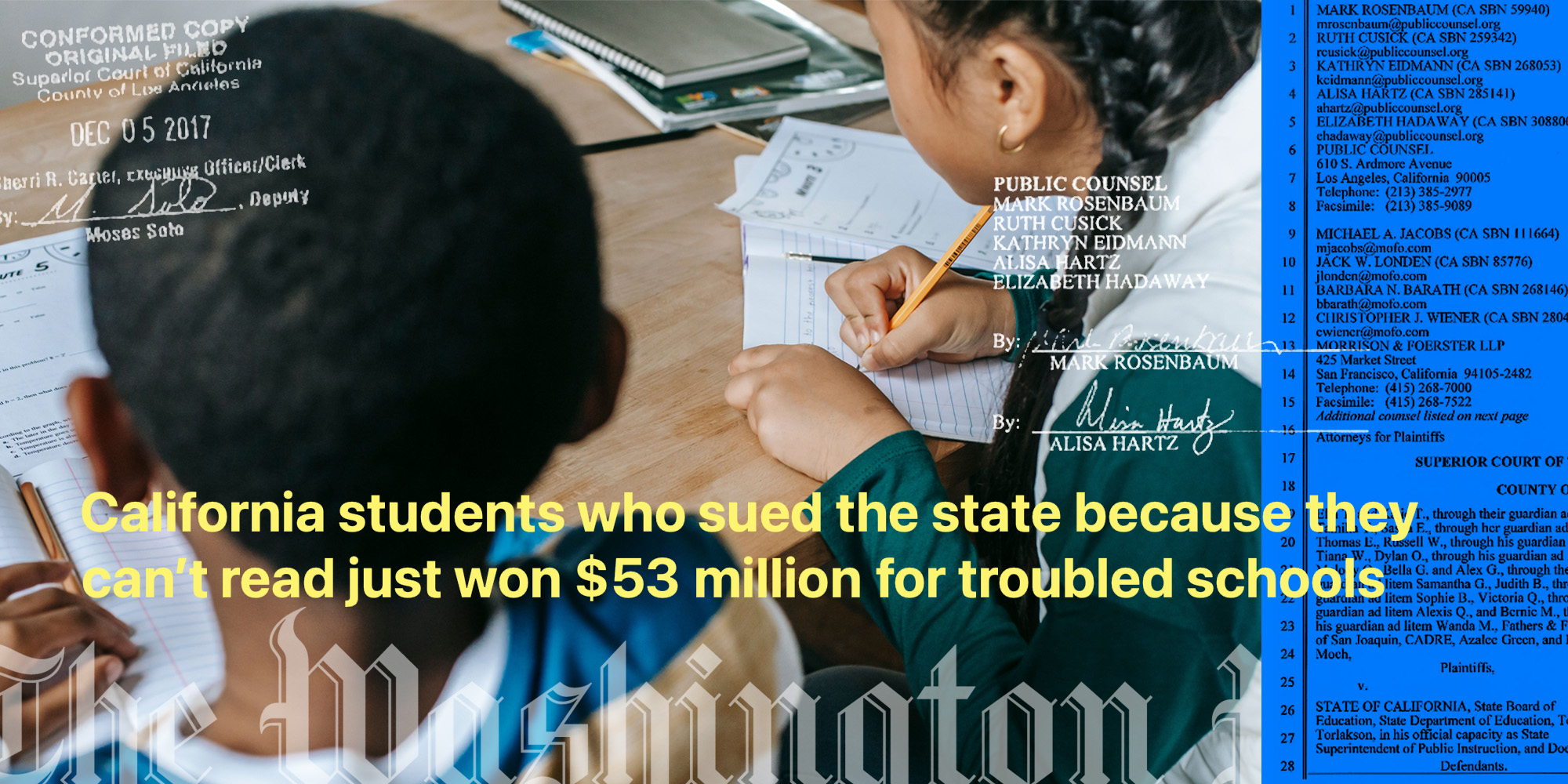
- Washington Post, California students who sued the state because they can’t read just won $53 million for troubled schools, 2/23/20
- AP News, California agrees to spend $50M to help kids who can’t read, 2/20/20
- LA Times, California students sued because they were such poor readers. They just won $53 million to help them, 2/20/20
- CalMatters, California will pay millions to settle suit claiming it violated children’s rights by not teaching them to read, 2/20/20
- Courthouse News, “Landmark $53 Million Deal Reached in California Literacy Challenge, 2/20/20
- Daily News, $50 million settlement OK’d to improve state’s student literacy, 2/20/20