
Lawsuit says the Trump administration’s rule targeting mixed-status families defies Congress, ignores HUD’s own analysis, and threatens housing for thousands of U.S. citizen children
- For media inquiries, email Alex Comisar with Actum here.
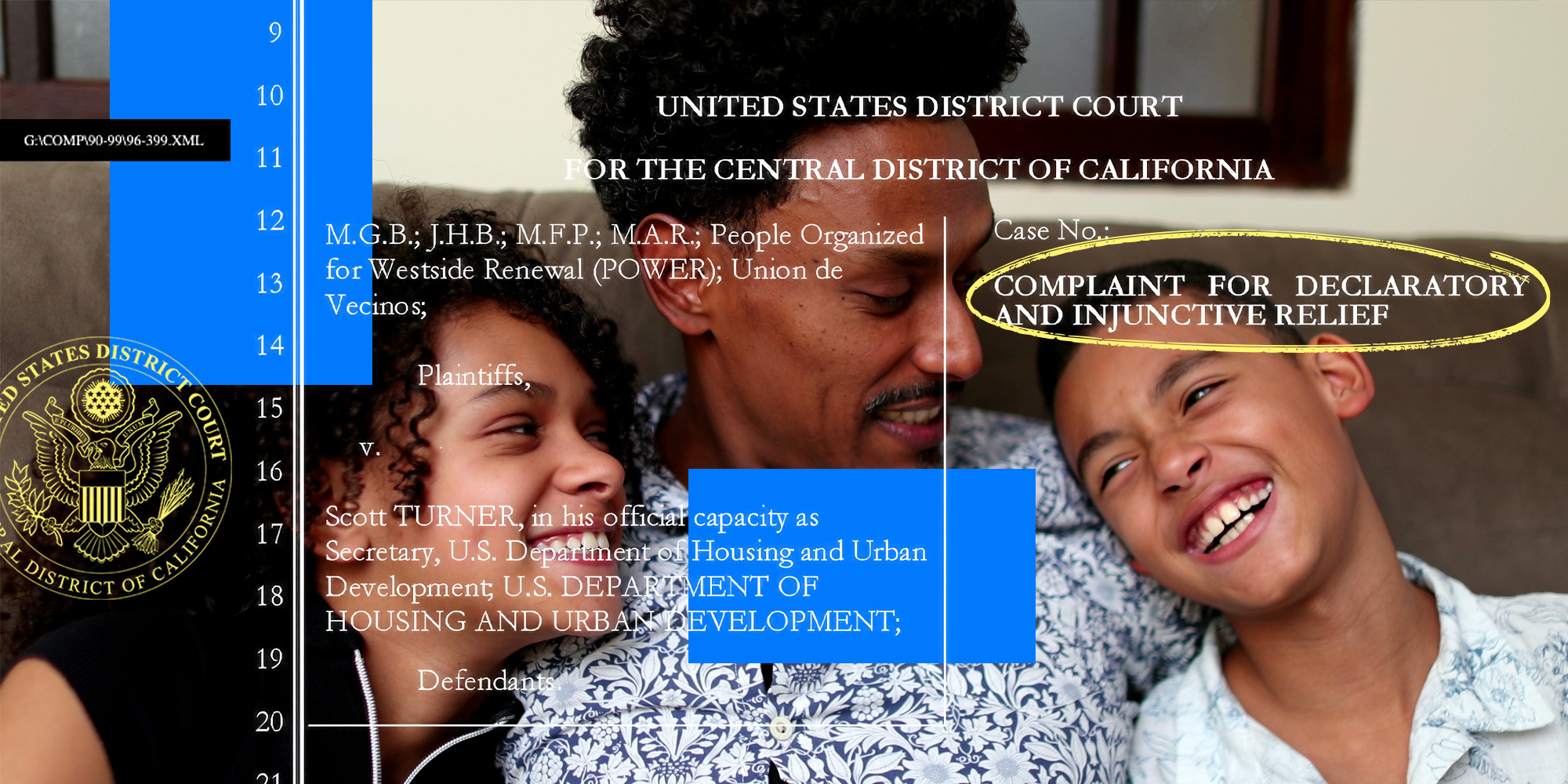
LOS ANGELES — Public Counsel, Kendall Brill & Kelly LLP, and Bird Marella LLP filed a lawsuit on November 16, 2026, in the U.S. District Court for the Central District of California challenging a new U.S. Department of Housing and Urban Development (HUD) rule that ends three decades of protections for mixed-status families in federally assisted housing. The suit is brought on behalf of People Organized for Westside Renewal (POWER), Union de Vecinos, and three Los Angeles County residents whose households receive HUD assistance. In the complaint, plaintiffs ask the court to postpone the rule’s December 14 effective date and prevent its enforcement in the Central District of California while the case proceeds.
For more than 30 years, mixed-status families (a household in which at least one family member has U.S. citizenship or eligible immigration status and at least one family member does not), have been able to live together in public housing and Section 8 homes. Their assistance is prorated so that only eligible members, often U.S. citizen children, are counted, and no ineligible person receives help. The new rule ends that approach. It requires every family member to verify their eligible status and makes prorated assistance temporary, so families that cannot document every member’s immigration status will lose their assistance unless they separate.
About 79,300 people nationwide live in mixed-status families receiving HUD assistance, including about 36,000 eligible children. As of 2024, California had the largest number of HUD-assisted mixed status households, accounting for 36 percent of mixed-status households in the country. Earlier data shows that a disproportionate share of people in mixed-status households were served in Los Angeles, most being citizen children living with at least one adult who had not claimed to be eligible for federal assistance.
HUD’s own analysis found that the rule would reduce the number of households served at current funding levels, and that keeping the same number of people housed would cost an additional $311 million to $385 million in Congressional funding. HUD also found that the rule puts the 36,000 currently eligible children at risk of losing their housing. HUD admitted it considered less harmful options, including protecting families already in their homes and exempting families with children, but rejected both despite acknowledging that families with children are likely to leave assisted housing together rather than separate.
“No family should have to choose between staying together and keeping a roof over their heads. Yet HUD’s rule would force precisely that choice on families across the country, including U.S. citizen children who could lose their homes because of their parents’ immigration status. Congress did not require this. HUD chose it,” said Amanda Mangaser Savage, Strategic Litigation Counsel at Public Counsel.
The harm will be felt sharply in Los Angeles, where roughly 73,000 people already experience homelessness and, without subsidies like the ones HUD provides, a household must earn more than $55 an hour to afford a two-bedroom apartment.
“This new HUD rule would push thousands of mixed-status families, including U.S. citizen children, out of their homes,” said David Alpert, Kendall Brill & Kelly LLP attorney. “Our clients are among them. One is a 26-year-old with cerebral palsy who has lived in his family’s home and relied on his parents and sister for care since he was a toddler. Another has lived in public housing since she was in second grade. Both now face losing their home or living apart from the family they depend on.”
“Los Angeles is home to some of our nation’s largest populations of mixed-status families, and the HUD rule would disproportionately threaten our most vulnerable communities – especially children – by putting their housing stability at risk simply because of their parents’ immigration status,” said Alexander H. Tran, Counsel at Bird Marella.
The lawsuit argues that the rule violates the Administrative Procedure Act, the Fair Housing Act, and the U.S. Constitution, and that it overrides the framework Congress created to keep mixed-status families together. It asks the court to declare the rule unlawful and set it aside as final relief.
The case is People Organized for Westside Renewal (POWER), Union de Vecinos, et al. v. U.S. Department of Housing and Urban Development, filed in the U.S. District Court for the Central District of California. Plaintiffs are represented by Public Counsel, Kendall Brill & Kelly LLP, and Bird Marella LLP.
###
About Public Counsel
Public Counsel is a nonprofit public interest law firm dedicated to advancing civil rights and racial and economic justice, as well as to amplifying the power of our clients through comprehensive legal advocacy. Founded on and strengthened by a pro bono legal service model, our staff and volunteers seek justice through direct legal services, promote healthy and resilient communities through education and outreach, and support community-led efforts to transform unjust systems through litigation and policy advocacy in and beyond Los Angeles.
About People Organized for Westside Renewal (POWER)
POWER is a membership-based community organizing group that employs a community organizing strategy based on relationship building and direct action to create meaningful change in the neighborhoods where it works. POWER works on issues that matter to people in its communities, such as affordable housing, community safety, and quality education. It is also part of a national movement focused on building an economy that works for everybody, challenging corporate power, and winning increasingly more inclusive and democratic government policies.
About Union de Vecinos
Union de Vecinos is a grassroots community organization that has organized tenants and residents in Boyle Heights and East Los Angeles since 1996. Through neighborhood committees, community organizing, popular education, and direct action, Union de Vecinos works to preserve affordable housing, prevent displacement, promote economic and environmental justice, and build healthy and stable neighborhoods.