
Education Equity
Holding the BIE Accountable to Provide Equal Educational Opportunity to Native American Children
Case Overview
Our Clients
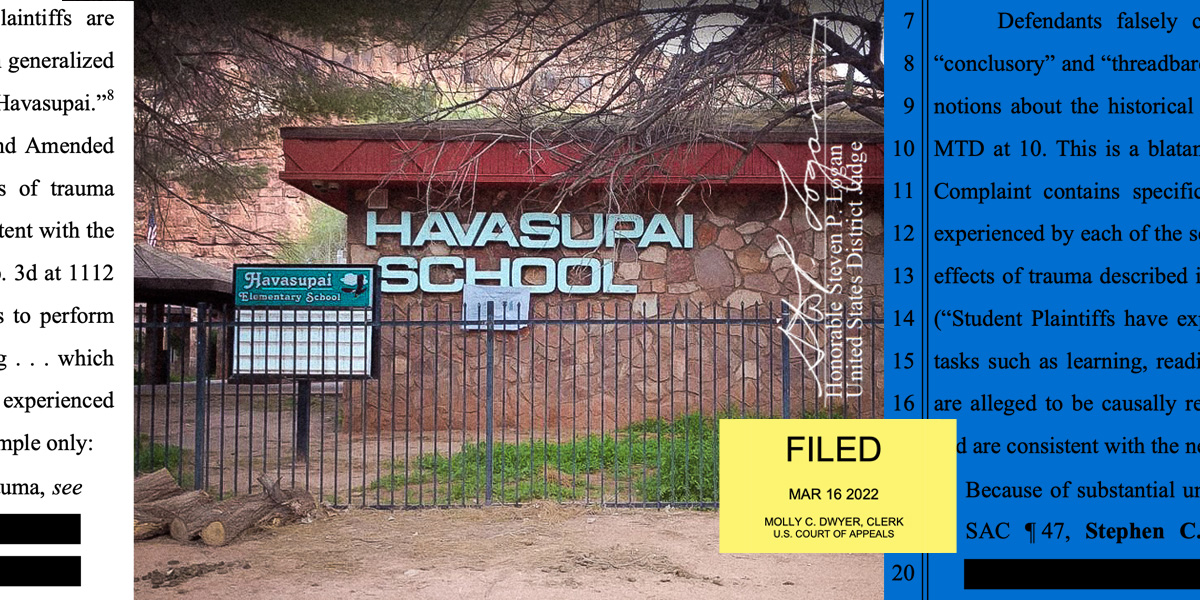
Six Havasupai children and the Native American Disability Law Center brought this case to ensure that all Havasupai children have access to equal educational opportunities through the only source of public education: the Havasupai Elementary School, which serves grades K through 8. The school is operated by the Bureau of Indian Education (BIE) and is located in the Havasupai Tribe’s ancestral lands at the bottom of the Grand Canyon in Northern Arizona. For years, Havasupai children, including those with disabilities, have been denied the educational opportunities to which they are entitled. The school, for example, does not even offer instruction in subjects beyond reading and math, and is continually plagued by high turnover, vacancies, and closures.
In January of 2017, Public Counsel, the Native American Disability Law Center, Stanford Youth and Education Law Project, Munger Tolles & Olson LLP, and Sacks Tierney P.A. filed a federal civil rights lawsuit against the BIE on behalf of Havasupai students and organizational Plaintiff Native American Disability Law Center for failing to provide required educational opportunities. The lawsuit seeks compensatory education and injunctive relief, including providing comprehensive educational curriculum; a system for the delivery of special education services to students with disabilities; and appropriate wellness and mental health resources for all students.
In September 2020, the parties reached a partial agreement requiring the BIE to take necessary steps to fulfill its obligation to ensure students with disabilities at Havasupai Elementary School receive equal access to education under Section 504 of the Rehabilitation Act of 1973 (Section 504), a general civil rights law protecting the rights of all students with disabilities including those who attend schools funded or operated by the BIE. As a result of this partial settlement, the BIE enacted a national policy that protects the rights of students with disabilities under Section 504 which applies to all schools operated by the BIE.
After U.S. District Court Judge Logan issued a decision that prevented the students from challenging the BIE’s failure to comply with discrete legal requirements at the Havasupai Elementary School, the Plaintiffs appealed to the U.S. Court of Appeals for the Ninth Circuit and prevailed there.
On May 18, 2023, Judge Logan dismissed the case after the parties presented a Settlement Agreement to the Court. As a result of the full settlement, all students who have attended the school over the last ten years will qualify for funding for additional educational and vocational activities to make up for the failures of the BIE. The settlement also requires a compliance specialist who will monitor the BIE’s compliance with the regulations and issue annual reports for the next five years. In addition, for five years, an independent community facilitator will be available to work with the community and the school to make sure that the BIE follows through on its required changes.
Court
U.S. District Court for the District of Arizona
U.S. Court of Appeals for the Ninth Circuit
Status
Settled
Case No.
3:17-cv-08004-SPL (District Court)
21-15097 (Ninth Circuit)
Filed
01/12/2017
our Organizational Client
our Organizational Partner
Public Counsel Legal Team
our Co-Counsel
Case Developments
Update
06/15/2026
BIE Annual Report Shows Dramatic Improvement in Havasupai Elementary School Compliance with Federal Regulations
The BIE is required to provide Annual Reports regarding its compliance with the federal regulations and to develop work plans to bring the Havasupai Elementary School into compliance with its obligations to provide education to students at the school. The June 2026 Annual Report shows Havasupai Elementary School’s rate of compliance with its federal obligations has grown dramatically from 22% in February 2025 to 87% in June 2026. The BIE reported that increased on-site curriculum and instructional support contributed to the improvement. Over the next year, BIE plans to focus on Culture and Language, instructional leadership capacity, and sustainable systems.
Update
03/17/2026
BIE Reports Reflect Development of Important Educational Policies and Provision of Student Activities in 2026
The BIE is required to provide Annual Reports regarding its compliance with federal regulations and to develop work plans to bring the Havasupai Elementary School into compliance with its obligations to provide education to students at the school. The first work plan of 2026 reflects necessary foundational improvements, such as standardizing instructional lessons, establishment of a library committee, provision of student activities, and improved family engagement. In addition, the work plan targets specific future activities, including developing a framework for embedding cultural content across subjects to be submitted for tribal approval. The full set of BIE reports required by the Stephen C. settlement can be found here.
Ruling
05/18/2023
Court Grants Final Approval of the Settlement Agreement
On May 18, 2023, Judge Logan dismissed the case after the parties presented a Settlement Agreement to the Court. As a result of the full settlement, all students who have attended the school over the last 10 years will qualify for funding for additional educational and vocational activities to make up for the failures of the BIE. The settlement also requires a compliance specialist who will monitor the BIE’s compliance with the regulations and issue annual reports for the next five years. In addition, for five years, an independent community facilitator will be available to work with the community and the school to make sure that the BIE follows through on its required changes.
Ruling
03/16/2022
Ninth Circuit Rules Federal Government Can Be Held Accountable for Its Failure to Provide General Education to Native American Students
On March 16, 2022, the Ninth Circuit handed down a historic ruling confirming that the federal government can be held accountable for its failure to provide general education to Native American students. The Court held that, under the Administrative Procedure Act, students at Havasupai Elementary School can compel the BIE to follow its own regulations and provide general educational services. The Court also held that students may seek the remedy of compensatory education to make up for educational services that should have been provided.
Filing
06/25/2021
Plaintiffs File Opening Brief With Ninth Circuit
A group of student Plaintiffs and the Native American Disability Law Center filed their opening brief in the Ninth Circuit. The brief seeks to reverse a court decision that prevented the students from challenging the BIE’s failure to comply with discrete legal requirements at Havasupai Elementary School. The Havasupai Tribe, as well as several organizations and professors, filed amicus briefs in support of the Plaintiffs.
Appellants’ Opening Brief – Ninth Circuit
The Havasupai Tribe Amicus Brief In Support of Plaintiffs
THE NATIONAL INDIAN EDUCATION ASSOCIATION, ET AL. Amicus Brief in Support of Plaintiffs
Administrative Law Professors Amicus Brief in Support of Plaintiffs
American Indian Law Scholars Amicus Brief in Support of Plaintiffs
EDUCATION CIVIL RIGHTS ALLIANCE, Et Al. Amicus Brief in Support of Plaintiffs
Settlement
10/02/2020
Parties Reach Partial Settlement
Judge Logan approved a historic settlement in a civil rights lawsuit brought by students attending Havasupai Elementary School and the Native American Disability Law Center, addressing the wholesale denial of educational opportunities for Native American students with disabilities. The settlement resolves only the claims challenging the BIE’s failure to meet the needs of students with disabilities; the Plaintiffs will appeal Judge Logan’s denial of the claims challenging the denial of basic general education to the Ninth Circuit.
Filing
05/31/2019
Plaintiffs File Motion for Summary Judgment
Plaintiffs’ Motion for Summary Judgment and Memorandum in Support Oral Argument Requested
Ruling
03/29/2018
Court Denies Defendants’ Motion to Dismiss
In a historic ruling, Judge Logan denied the federal government’s motion to dismiss claims brought by Havasupai students and the Native American Disability Law Center. The Court ruled, for the first time in the nation, that the federal government must meet the educational needs of Native American students attending schools run by the BIE by affirmatively addressing the mental health and wellness needs of students impacted by trauma and childhood adversity.
Filing
08/09/2017
Defendants File Partial Motion to Dismiss
The Department of Justice filed a partial motion to dismiss, which, among other things, sought to dismiss students not currently enrolled in Havasupai Elementary School from the case and to dismiss student claims for appropriate mental health and wellness resources. On September 5, 2017, the Havasupai Tribe and the Society of Indian Psychologists filed amicus briefs in support of the student Plaintiffs. On October 24, 2017, Judge Logan heard oral argument on the Defendants’ motion. Because the motion filed by the Defendants is only a partial motion to dismiss, the case will move forward regardless of Judge Logan’s ruling.
Defendants’ Partial Motion to Dismiss
Plaintiffs’ Opposition to Partial Motion to Dismiss
The Society of Indian Psychologists’ Amicus Brief in Support of Plaintiffs
Filing
01/12/2017
Plaintiffs File Complaint
Havasupai students sued the U.S. government for failure to provide equal educational opportunity.
Press Releases
Press Release
03/17/22
Havasupai Students Achieve Watershed Legal Victory for Native Education Rights
Learn MorePress Release
10/03/20
Historic Settlement Reached in Advancing the Educational Rights of Native American Students
Learn MoreMedia
- ICT News, A reporter treks into Havasupai lands to learn about education, 3/6/25
- The Hechinger Report, How a tribe won a legal battle against the federal Bureau of Indian Education — and still lost, 2/22/25
- Lee Enterprises Wire, Native American kids cite abuse, danger at understaffed school, feds join calls for reform, 12/5/24
- KJZZ, “Havasupai plaintiffs hope their lawsuit forces change at the Bureau of Indian Education,” 4/19/22
- AP, “Federal court revives claim in Havasupai education case,” 3/17/22
- KJZZ, “Arizona tribe members settle education claims in lawsuit,” 10/6/20
- AP, “Arizona tribe members settle education claims in lawsuit,” 10/5/20
- Arizona Republic, “Havasupai students who sued for a better education reach settlement with federal government“, 10/2/20
- IndianZ.com, “Lessons Lost: Indian students have been shortchanged for generations,” 8/10/20
- AP, “Lawsuit seeks education reform at Native American schools,” 7/24/20
- Mic, “On the Havasupai Indian Reservation, a failing school has sparked a battle against the government,” 4/30/17
- The Republic, azcentral.com, “A hidden tribe, a disastrous school and finally, a cry for help,” 3/15/17
- Indian Country Today, “Landmark Civil Rights Lawsuit Pits Havasupai Children Against the BIE,” 2/23/17
- Indian Country Today, “Havasupai Children File Suit Against BIE for Failed Education,” 1/26/17
- The New York Times, “Barely 2 R’s Are Taught at School That Led Tribe to Sue U.S.,” 1/23/17
- Navajo Times, “Havasupai students, NADLC, sue the BIE,” 1/20/17
- The Arizona Republic, “Havasupai students sue federal government for better teachers,” 1/18/17
- Cronkite News, “Lawsuit claims Havasupai students are deprived of ‘basic general education’,” 1/18/17
- Arizona Daily Sun, “Lawsuit faults Bureau of Indian Education schools,” 1/13/17
- KJZZ 91.5, “Lawsuit: US Failed To Provide Havasupai Children With Education Materials, Classes,” 1/13/17
- National Native News, News Broadcast at 1:47, 1/13/17
- The Atlantic, “The Longstanding Crisis Facing Tribal Schools,” 1/12/17
- Washington Post, “U.S. government has ‘dismally failed’ to educate Native American children, lawsuit alleges,” 1/12/17
- The Huffington Post, “Native American Students Sue The U.S. Government Over Dismal Education,” 1/12/17
- Mic, “9 Havasupai Native American children are suing the US Bureau of Indian Education. Here’s why.” 1/12/17
- The Chronicle of Social Change, “Bureau of Indian Education Failed to Educate Tribal Youth, Lawsuit Alleges,” 1/12/17
- Education Week, “Tribal Students Sue Feds Over ‘Shock the Conscience’ Schooling Conditions,” 1/12/17
FAQ
Below are the answers to commonly asked questions about this federal civil rights action vindicating the educational rights of Native American children.
What is this case about?
This case is about ensuring that all Havasupai children have access to equal educational opportunities through the only source of public education provided on the reservation: the Havasupai Elementary School, which serves grades K through 8.
For years, Havasupai children, including those with disabilities, have been denied the educational opportunities to which they are entitled. The school, for example, does not even offer instruction in subjects beyond reading and math, and is continually plagued by high turnover, vacancies, and closures. These problems, along with numerous others, have profoundly harmed children’s educational outcomes. This case seeks to hold the federal government accountable for honoring its legal obligations toward Native American students so that all children have the opportunity to learn and fulfill their potential.
What are the goals of the lawsuit?
The goals of this lawsuit are to ensure that Native children have access to the education to which they are legally and morally entitled. Specifically, this suit aims to hold the Bureau of Indian Education (BIE) legally responsible for the quality of the educational opportunities and wellness resources offered at BIE schools. It asks the BIE to comply with its obligation to expand the educational curriculum and learning resources at the Havasupai Elementary School; to provide a system for the delivery of special education services to students with disabilities; and to offer appropriate wellness and mental health resources for all students.
What is the Havasupai nation and where is it located?
The Havasupai are a federally recognized Native American tribe who have resided for centuries in the base of the Grand Canyon. The Havasupai reservation currently consists of tribal land along the western corner of the Grand Canyon’s South Rim in Arizona.
Who has the responsibility for providing education to Havasupai students?
Under federal law, it is the federal government, specifically the BIE, which carries the ultimate legal responsibility for providing equal educational opportunities to students at the Havasupai Elementary School. The BIE directly operates and funds the Havasupai Elementary School.
What is the BIE?
The BIE is a federal agency within the Department of the Interior, which is responsible for ensuring quality educational opportunities for Native American youth. The BIE funds approximately 184 elementary and secondary schools across the country, and directly operates about 58 of those schools, including the Havasupai Elementary School. In the 2006-07 school year, the BIE school system served nearly 48,000 Native students.
Who is bringing this case?
This case is being brought by four Havasupai children and the Native American Disability Law Center, a non-profit legal services organization that serves the needs of Native Americans with disabilities in the Four Corners region. Together, these Plaintiffs seek to ensure the adequacy of the educational opportunities afforded to children attending the Havasupai Elementary School.
Who are the Defendants?
The lawsuit is against the United States government. Specifically, the Defendants are the federal agencies, and officials in those agencies, responsible for ensuring the quality of the educational opportunities afforded to Native children attending BIE-operated schools, including the Havasupai Elementary School.
What laws are the Defendants violating?
The Defendants are in violation of numerous federal laws regulating the content and quality of the education provided at BIE-operated schools. These laws mandate, for example, that BIE schools provide a comprehensive general education curriculum that includes a diverse range of subjects and content areas. They further require the provision of appropriate instructional resources and extracurricular activities; the engagement of the local community in school decision making; and the integration of Native language and culture into school classrooms. The federal government has wholly failed to meet any of these requirements, as well as a number of other laws related to the provision of general education.
In addition, the government has violated Section 504 of the Rehabilitation Act of 1973, which prohibits discrimination in educational programs operated by the federal government. Specifically, the BIE has failed to provide a system for the delivery of special education to children with disabilities or provide necessary wellness and mental health supports to ensure that all Havasupai children have an opportunity to learn. Moreover, the BIE has failed to comply with federal laws protecting the procedural rights of children with disabilities and their families, and ensuring that they are properly identified and notified of their educational rights.
Who are the lawyers?
The lawyers bringing this suit are a coalition of legal services organizations and private law firms delivering pro bono services. This coalition includes three legal non-profits (the Native American Disability Law Center, Public Counsel, and the American Civil Liberties Union of New Mexico), the Stanford Youth and Education Law Project, and two law firms (Munger, Tolles and Olson LLP and Sacks Tierney P.A.).
Where is the case being filed?
The case is being filed in federal court in the United States District Court for the District of Arizona.
How can I get involved?
You can get involved by contacting your locally elected congressional representatives, and sharing news about this story with your friends and family on social media. Stay updated on the case by visiting the Stephen C. v. Bureau of Indian Education page on Public Counsel’s website.
Does the tribe support the case?
Yes, this case is brought with the support of the tribe. The Havasupai Tribal Council has passed a resolution in support of our efforts to improve education through this lawsuit.
Why is the school located in a relatively remote location?
The remoteness of the school in Supai stems from a history of federal government discrimination toward the Havasupai and their right to reside on their once-expansive tribal homelands. The center of the Havasupai reservation is Supai, which is located at the base of Havasu Canyon within the Grand Canyon. The Havasupai reservation represents a fraction of the Havasupai’s original homelands in the Grand Canyon. Over time, a legacy of coercive federal policies forced the Havasupai onto a reservation that consisted mostly of lands at the canyon bottom. In light of this history, it is incumbent on the federal government to provide adequate educational opportunities to Havasupai children in their tribal communities and on the land that the federal government set aside for the use of the Havasupai people.
Why can’t families move out of the canyon in search of a better education?
For the Havasupai, and many Native communities, tribal lands form an integral part of their identity as a people. The Havasupai remain deeply rooted in their ancestral homelands in the Grand Canyon, where they have resided for centuries. In fact, federal regulations specify that the federal government provide a public education “close to home,” 25 C.F.R. § 32.4(p), and the vast majority of BIE schools are operated on reservations where children’s families and communities are located. In light of past federal policies that forced Native children to attend abusive and assimilationist boarding schools, many families are understandably eager to have their children educated in their community, where they can learn about their culture and identity, and where community members can remain invested and involved in local schools.
What is a culturally relevant education and why is it important?
Culturally relevant education refers to a holistic approach that integrates Native history, values, language, and cultural into the school curriculum and delivery of that curriculum in the classroom. Culturally relevant education carries significant academic benefits for students, and is consistent with federal regulations, which mandate a system of multilingual and multicultural education at BIE schools
Can the same educational problems be found at other BIE schools?
The problems at the Havasupai Elementary School are emblematic of problems faced by children at other BIE schools across the country. As the federal government has long been aware, BIE schools have been lagging behind for years. Numerous federal officials have acknowledged these profound federal failures in tribal education. Secretary Sally Jewell of the Department of the Interior, for example, openly declared before the Senate Indian Affairs Committee that “Indian education is an embarrassment to you and us.” As detailed in numerous federal reports, including a string of investigations from the federal government’s General Accounting Office, these problems are not unique to Havasupai but have permeated the network of schools that the BIE helps administer across the country, causing similarly indefensible deficits in student achievement.
Does this lawsuit consider the importance of tribal sovereignty?
Yes, this lawsuit emphasizes the need for greater tribal involvement and community oversight in school decision-making, as well as the critical importance of Native language and culture in the classroom. Although the BIE is the federal government agency charged with administering the Havasupai Elementary School, it is legally bound to provide specific avenues for community engagement in school decision-making, and to ensure that the education provided is culturally relevant and reflective of Native culture, language, and history, in consultation with the local community that the school is meant to serve.
How is the federal responsibility to Native American students different than the federal responsibility to other students?
Consistent with longstanding federal law and policy, Native American students are entitled to educational opportunities that are equal to or exceed those provided to other students around the nation. Specifically, the federal government is bound by a specific set of regulations and laws that ensure the quality and appropriateness of the general education at BIE schools, and that additionally provide for the integration of Native language and culture into the educational system.
Isn’t public education a state law issue?
For the network of BIE schools serving reservation communities, including the Havasupai Elementary School, public education is provided directly by the federal government to Native students through the BIE. This federal responsibility for Native education stems from well-established federal law and reflects the longstanding trust relationship between the federal government and Native American tribes.
What is the trust doctrine?
The trust doctrine refers to a series of legally enforceable fiduciary obligations arising from the historic trust relationship between the federal government and Native American tribes. Under the obligations of the trust doctrine, the federal government is responsible for protecting Native rights, lands, assets, and other resources, including honoring its commitments with respect to Native education.